


There’s a version of the AI conversation circulating in project management circles right now that feels incomplete.
As AI in project management becomes more common, most of the conversation has centered on tools and automation. It focuses on prompts, workflows, and efficiency. It asks how quickly we can generate project briefs, summarize meetings, draft timelines, or produce risk logs. AI tools for project managers are framed primarily as productivity levers, which, to be fair, they absolutely are. If you can reclaim time from repetitive tasks, that’s a win.
But if that’s the only lens we use, we miss the real shift.
AI isn’t fundamentally changing project management by taking tasks off your plate. It’s changing it by making the visible artifacts easier to produce, which means the invisible work becomes harder to ignore.
When AI tools make artifacts easier, project management thinking gets exposed
For years, a certain kind of project management competence was measured by output. Plans looked organized. Status reports were polished. Decks were thorough. The machinery of coordination ran smoothly enough to signal control. Now those artifacts can be generated in seconds, often with language that sounds confident and structured enough to pass in most rooms.
When documentation becomes easy, something uncomfortable surfaces: If the plan isn’t the value, what is?
That question lands differently depending on how you’ve understood your role as a project manager.
If you’ve defined your contribution primarily as coordination and documentation, this moment can feel destabilizing. If you’ve always understood project management as influence, framing, and protecting shared understanding under pressure, this moment clarifies your importance.
The pressure isn’t about speed anymore. It’s about judgment.
AI can organize the work. Project managers still shape how it feels.
AI can produce a clean project outline. It can summarize a complex conversation and identify plausible risks. What it cannot do is determine which risk actually matters in this organization, given these personalities and these constraints. It doesn’t understand the political subtext of a “yes.” It can’t sense (yet?) when a team is nodding because they’re tired rather than aligned. And it really cannot recognize that a small change request is actually a strategic pivot in disguise.
These are contextual decisions. They require interpretation and discernment, which means they require a human being who understands the nuance of the situation.
And if we’re honest, that has always been the real work of strong project managers.
What AI actually does is remove some of the administrative friction that used to obscure that reality. When you’re no longer spending hours drafting the first version of every update, recap, or project plan, your role shifts. You’re no longer primarily generating content; you’re shaping thinking.
That shift is significant. You’re not editing for grammar or formatting. You’re evaluating assumptions, tightening logic, identifying gaps, and ensuring the work aligns with what the team is actually trying to accomplish.
That distinction matters.
The future of project management is cognitive leadership
Creative intelligence, in this context, is not about being imaginative for its own sake. It’s about cognitive leadership. It’s the ability to examine a well-structured draft and ask whether it reflects reality. It’s knowing when momentum is masking misalignment. It’s slowing a conversation down long enough to clarify what success actually means before the team moves forward on an assumption.
AI increases output. Creative intelligence protects outcomes.
We’re exploring this shift in depth inside PM Squad with our new playbook, Creative Intelligence for PMs, which focuses on integrating AI into project management without outsourcing judgment.
As output accelerates, weak thinking becomes more expensive. A polished document can create the illusion of clarity, and in a fast-moving environment, illusion travels quickly. The project moves forward. The cracks appear later. The cost is higher because the confidence was higher.
That dynamic is not new. What’s new is how efficiently AI can now scale it.
The future of project management will not be defined by who can generate the cleanest plan the fastest. It will be defined by which project managers can interpret, challenge, and shape what AI produces.
Will AI replace project managers? That’s the wrong question.
This is why the real question for PMs is not, “How do I use AI?” The better question is, “How do I remain indispensable when the artifacts are easy?”
That question forces a deeper inventory of your value. It pushes you to examine whether you are primarily a task coordinator or a decision shaper. It asks whether you are comfortable challenging a draft that looks finished but feels off. It asks whether you are willing to hold tension in the room long enough to protect the work.
No tool can manufacture those skills, because they are fundamentally about leadership and human judgment.
If you’ve been leading with context, influence, and pattern recognition all along, AI doesn’t shrink your role. It sharpens it. It removes some of the noise and places your judgment in clearer view. If you’ve relied mostly on documentation and process mechanics, this moment is an invitation to evolve rather than a signal that project management is being automated.
AI handles admin. You handle people, decisions, and clarity.
A practical shift for project managers using AI
There’s a practical way to start making that shift.
The next time you use AI to draft something for a project, resist the instinct to treat it as a nearly finished product that simply needs tone adjustments. Instead, review it as if you were responsible for the consequences of every assumption embedded within it. Ask whether it reflects the actual capacity of your team. Ask whether it locks in a definition of success that everyone has truly agreed to. Ask what would break if the plan were executed exactly as written.
That pause is not inefficiency. It is discernment.
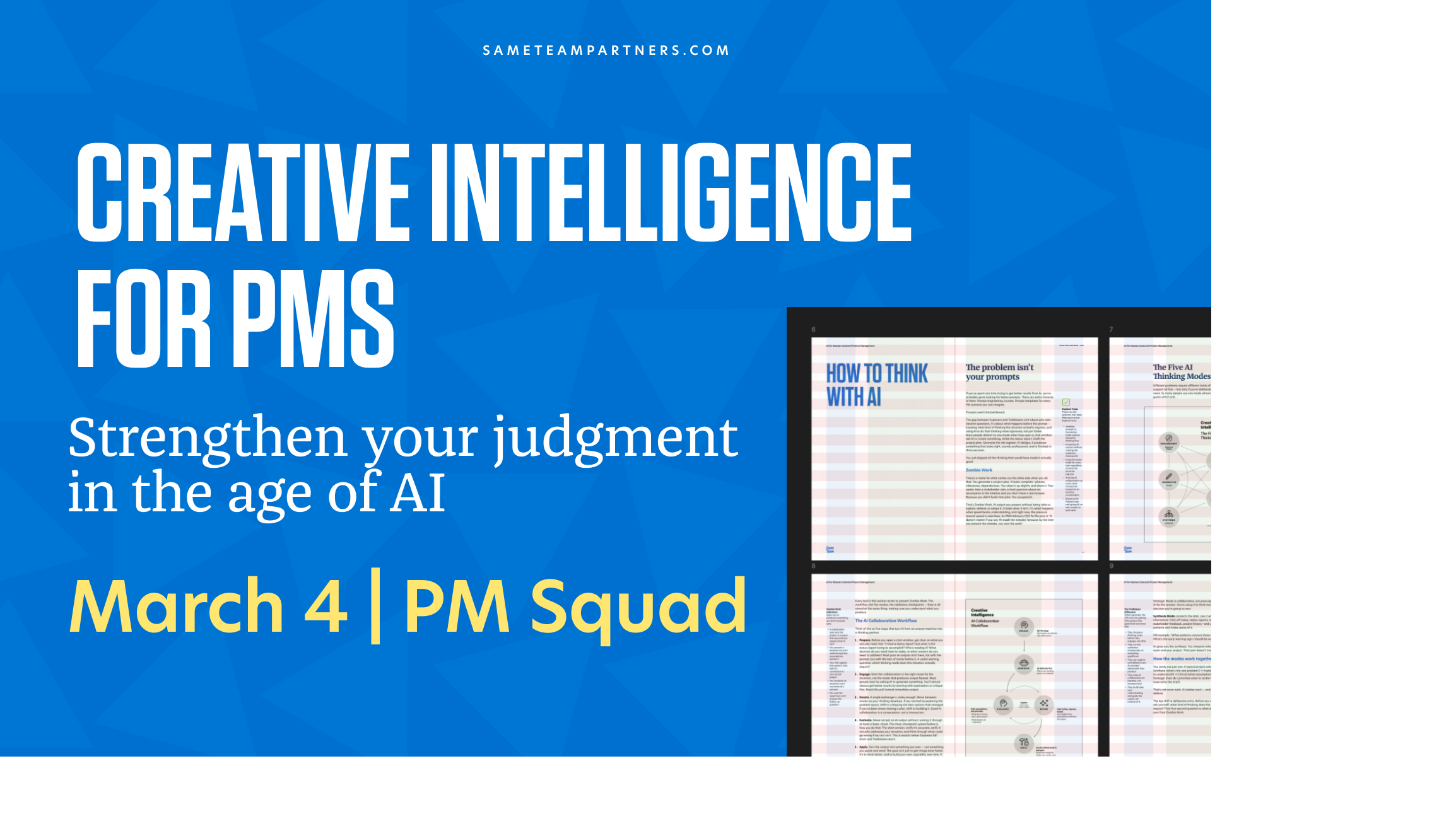
On March 4, we’re releasing Creative Intelligence for PMs inside PM Squad.
It’s a practical guide to using AI in project management while strengthening discernment, decision-making, and leadership. If this article resonates, the playbook takes it further.
TL;DR
AI in project management makes artifacts easier to produce, but it doesn’t replace leadership. As AI tools for project managers and AI for project managers accelerate output, judgment becomes the differentiator. The future of project management belongs to PMs who can interpret, challenge, and contextualize what AI generates while remaining indispensable because of it.


